
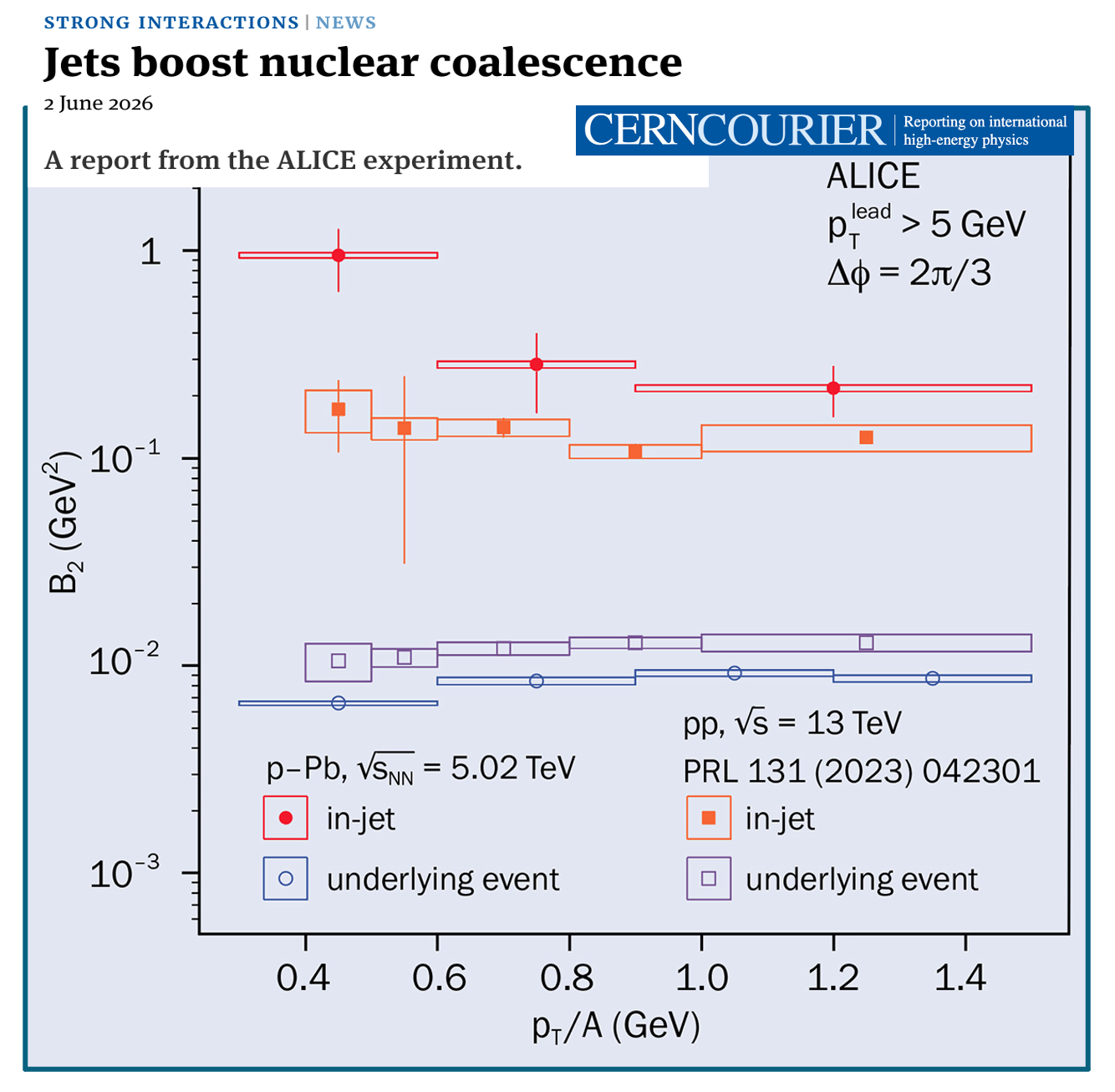
(Figure 1: Deuteron coalescence parameter B2 in jets (full markers) and out of jets (open markers) in p-Pb collisions at a centre-of-mass energy per nucleon pair of 5.02 TeV (circle markers) compared with the measurements in pp collisions at a centre-of-mass energy of 13 TeV (square markers).)
Energy Frontier Article in CERN Courier May - June 2026
Link to CERN Courier May - June 2026 Digital Edition
Jets boost nuclear coalescence
2 June 2026
The production mechanism of light (anti)nuclei in hadronic collisions has been studied in several experiments over the past decades, but is still not fully understood. One candidate mechanism is baryon coalescence, in which nuclei can form from preexisting nucleons only if they are close in phase space. The ALICE collaboration has now reported the first measurement of deuteron production in and out of jets in p-Pb collisions at a centre-of-mass energy per nucleon pair of 5.02 TeV. The results are consistent with the enhancement expected from coalescence models.
Jets, the collimated emission of hadrons produced by the hadronisation of high-energy quarks, are a natural testing ground for coalescence, as the nucleons they contain are typically close in phase space. Comparing yields inside and outside jets can then test the mechanism directly. In the ALICE analysis, the coalescence probability is investigated by calculating the coalescence parameter BA, defined as the ratio between the nucleus invariant yield and the proton invariant yield raised to the mass number A of the nucleus. This quantity is calculated both in (BjetA) and out of jets (BUEA), where UE represents the underlying event). In the latter, the density of produced particles is expected to be lower, and thus coalescence should be less likely. If proximity in phase-space affects the coalescence probability, BjetA should therefore exceed BUEA. Otherwise, the two should be similar.
Three regions of equal width are used to study the jet-correlated production: “toward”, “away” and “transverse” to the jet axis, with the direction approximated by the highest-transverse-momentum particle in the event. The in-jet contribution is obtained from the toward region by subtracting the underlying event, captured by the transverse region. Bjet2 appears to be enhanced with respect to BUE2 (see figure 1), as expected from coalescence models.
Compared to previous studies in pp data, the system formed in p–Pb collisions is slightly larger and produces more particles, providing additional constraints on coalescence. The enhancement of Bjet2 with respect to BUE2 is found to be larger in p-Pb than in the corresponding pp measurement at 13 TeV. This difference could be explained by the different source sizes and, possibly, by different particle-species compositions of the jets.
Further investigations of the coalescence parameter in and out of jets will be carried out with data from Run 3 of the LHC, which includes software-triggered pp data samples up to three orders of magnitude larger than those collected in Run 2. The full exploitation of this data will allow for the inclusion of A = 3 nuclei (3He, triton) and the extension of the transverse momentum coverage to higher values, providing additional information to constrain the processes behind the formation of light (anti)nuclei.
Further reading:
ALICE Collab 2026 arXiv:2602.22880.
ALICE Collab 2023 Phys. Rev. Lett. 131 042301.